Three training days per week is a sweet spot for people who want real gym progress without organizing their entire life around the gym. It offers enough weekly stimulus to build muscle and strength while leaving four days for recovery, work, family, and everything else.
The best split is not the one with the most exercises. It is the one you can repeat, track, and progress. Below is a complete three-day framework, plus options for adjusting it to your experience and schedule.
Why three days works
- Every major muscle group can be trained at least twice across the week.
- Recovery is easier than with five or six demanding sessions.
- Missed days are easier to reschedule.
- Sessions can stay focused instead of becoming random full-body marathons.
- Progress is simple to measure with a repeatable rotation.
The recommended split
Use an Upper / Lower / Full Body structure. Train Monday, Wednesday, and Friday or any pattern that places at least one rest day between sessions. The full-body day gives each major area a second weekly exposure without requiring another long workout.
Day 1: Upper body
- Bench press or dumbbell press — 3 sets of 6–10
- Chest-supported row — 3 sets of 8–12
- Overhead press — 2 sets of 8–12
- Lat pulldown or pull-up — 3 sets of 8–12
- Lateral raise — 2 sets of 12–20
- Biceps curl — 2 sets of 10–15
- Triceps pressdown — 2 sets of 10–15
Day 2: Lower body
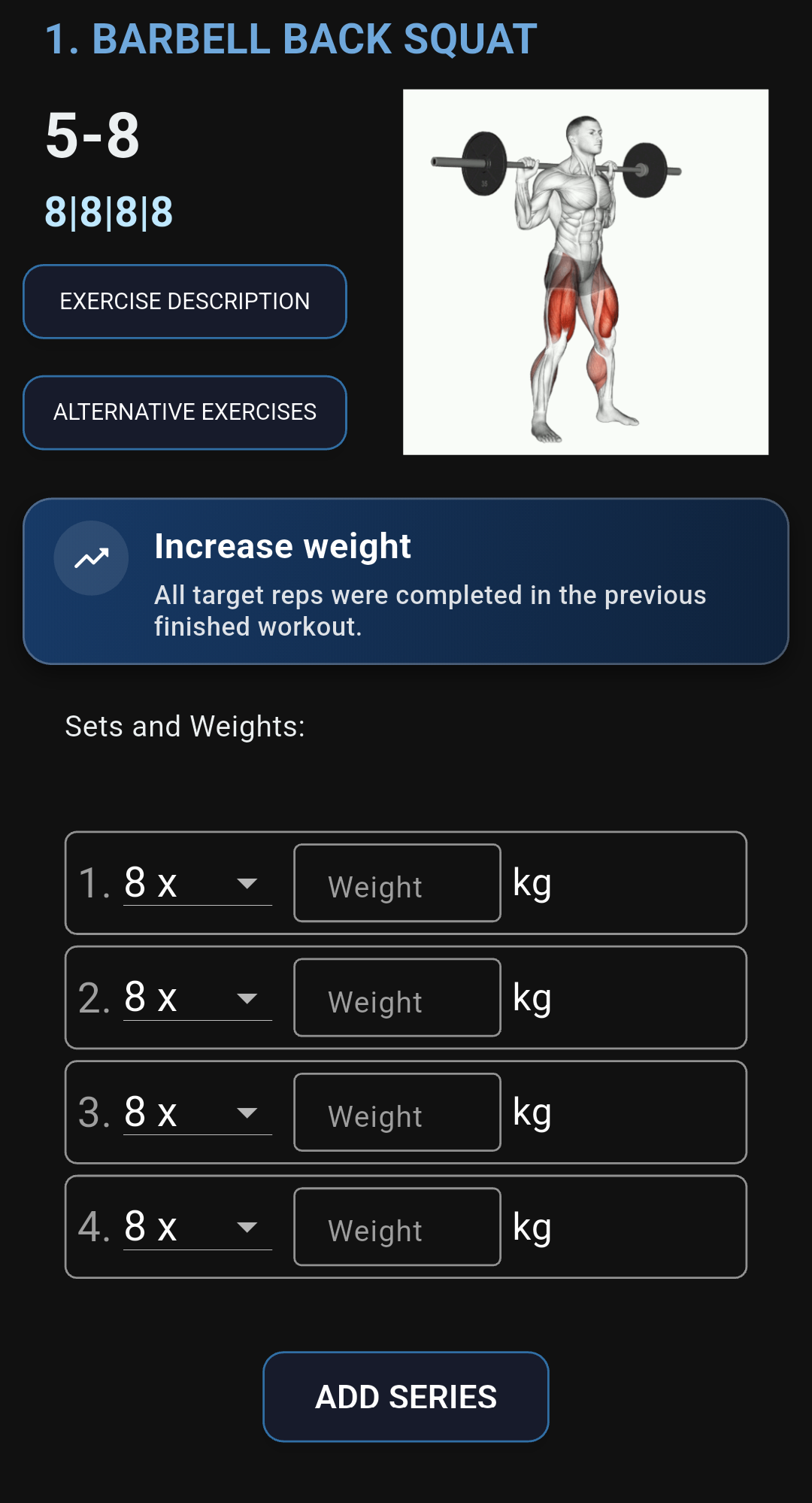
- Back squat or leg press — 3 sets of 6–10
- Romanian deadlift — 3 sets of 8–12
- Split squat — 2 sets of 8–12 per side
- Leg curl — 2 sets of 10–15
- Calf raise — 3 sets of 10–15
- Plank or cable crunch — 3 sets
Day 3: Full body
- Incline dumbbell press — 3 sets of 8–12
- Pull-up or pulldown — 3 sets of 6–12
- Goblet squat or hack squat — 3 sets of 10–15
- Hip thrust — 3 sets of 8–12
- Cable row — 2 sets of 10–15
- Lateral raise — 2 sets of 12–20
- Optional arm superset — 2 sets each
How long should each workout take?
Most sessions should take 50–75 minutes. Rest two to three minutes after demanding compound lifts and 60–90 seconds after smaller isolation exercises. If time is limited, pair noncompeting movements such as rows with presses or curls with calf raises.
How to progress
Use a rep range and add reps before adding load. When you complete the top of the range on all planned sets with clean technique, use the smallest practical weight increase. Our progressive overload guide explains the full system.
Adjustments for beginners
Start with two work sets on most exercises and keep one to three good reps in reserve. Use stable variations such as machine presses, leg presses, pulldowns, and chest-supported rows while you learn technique. Add volume only after recovery and consistency are established.
Adjustments for experienced lifters
Add a third or fourth set only to priority muscles. Keep the weekly structure stable for six to eight weeks, rotate rep ranges when useful, and avoid turning the full-body day into another maximal session. Its job is to deliver productive volume without compromising recovery.
What if you miss a day?
Continue with the next workout in the rotation. Do not cram two full sessions together to “catch up.” A Monday-Wednesday-Friday plan can temporarily become Monday-Friday-Sunday. The order matters more than the name of the weekday.
The bottom line
A strong three-day split is balanced, repeatable, and easy to progress. Start with the template, match exercises to your equipment, and record every set. Consistency over several months will outperform a more complicated plan you cannot maintain.